A Confidence Score is Not a Proof
AI patent tools answer claim questions with a confidence score that cannot be audited or reproduced. We break the claim into its limitations, map each to evidence, and formally prove how they combine. The result is a certificate anyone can re-check and reach the same answer.
AI can score a patent match in seconds, but a score is an opinion. This is how our research turns that analysis into something a skeptic can check.
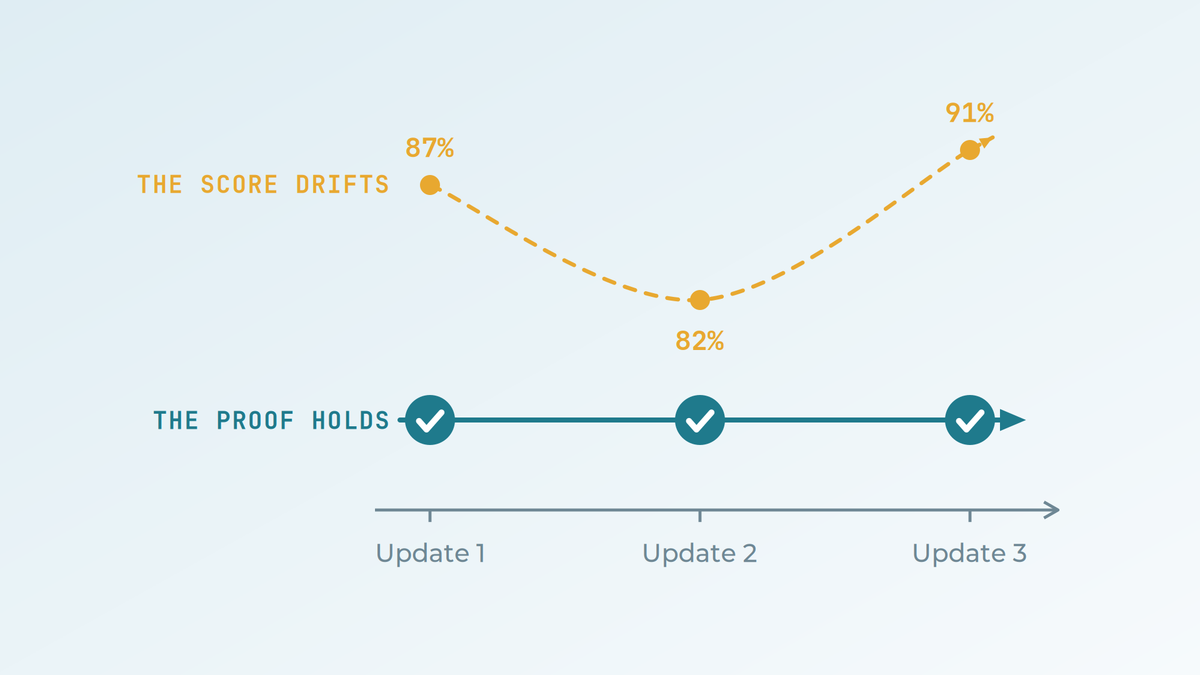
Picture the tool your firm just piloted. It reads a patent claim, reads a product's documentation, and reports an 87% match. The number looks precise, until you ask what it is 87% of.
The score reflects patterns in the model's training data. It cannot be audited, it does not say which element of the claim carried it, and it will move when the model is updated. For a decision worth millions, that is not evidence. It is a well-dressed opinion.
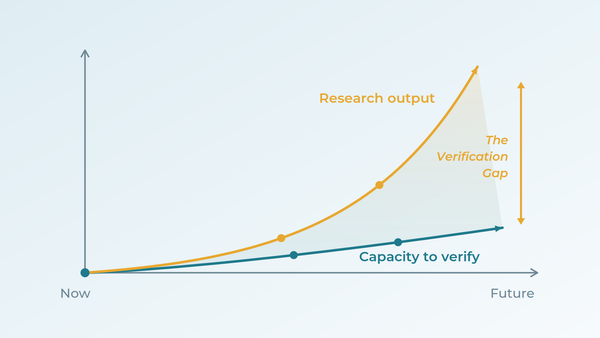
Part 1 of this series named the verification gap and argued for evidence over assertion. This part shows what that principle costs, and what it buys, in one of the hardest places to apply it, patent analysis.
Why patents are the hard case:
A patent claim is not one assertion but a structure of them. Analyzing it means breaking the claim into its individual limitations, mapping each limitation to evidence in a product or in prior art, and then reasoning about the whole.
Today that work happens in two ways, and both are strained. Expert claim charts are the gold standard, but a single claim-to-product comparison can take tens to hundreds of expert hours, and two experts will rarely produce the same chart. No firm can cover a portfolio of thousands that way.
AI tools scale, but they return probabilistic scores with no guarantees, and the scores do not combine. A claim is only met if every limitation is met, and an 87% on one element and a 92% on another do not multiply into anything meaningful about the claim as a whole.
Split the work at the right line:
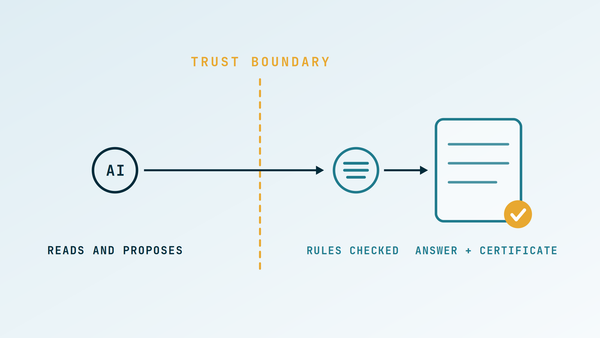
Our research draws a line through the pipeline, the same trust boundary from part 1. AI does only what genuinely requires AI. It reads the documents, extracts the evidence, and scores how well a product feature matches a claim element. Everything after that line is mathematics that can be checked.
The claim becomes a map. Every limitation is a node, weighted by its legal role, and every logical dependency is an edge. Scores flow through that map under rules that are themselves proven correct, including a weakest-link rule. If a limitation that others depend on falls below the satisfaction threshold, everything built on it goes to zero.
The worked example in the paper shows why this matters. Under one reading of the claim, a single element scores 0.58 against a 0.65 threshold. That one shortfall cascades and zeroes out three downstream limitations. A flat similarity score would never surface that. The structure is where the legal meaning lives.
Proof you cannot fake:
The output is not a score but a certificate. It bundles the claim-to-evidence mapping every attorney already knows with a formal proof that every computation on top of it followed the stated rules. The proof is written in Lean 4, a proof assistant, which is software that checks mathematical proofs the way a compiler checks code, and is already used in industry to verify security-critical systems. Anyone can re-check the certificate independently. To the best of the paper's knowledge, this is the first time interactive theorem proving has been applied to intellectual property analysis.
One detail is worth savoring. Proof assistants include an escape hatch, a placeholder literally named sorry, that lets an unfinished proof pass a surface check. A fraudulent certificate claiming 100% coverage with placeholder proofs would slip past a naive checker. So the framework also audits what the proof rests on, and accepts a certificate only if it stands on the ordinary foundations of mathematics. A certificate cannot be faked. It can only be earned.
What is proven, and what is not:
This is the part we care most about getting right. The guarantee is conditional, and the paper says so up front. The AI's readings of language are not proven correct, because nothing can prove that today. What is proven is that everything computed from those readings follows the stated rules exactly. The paper compares it to a verified calculator. The arithmetic is guaranteed, and the figures you type in are your responsibility.
Every result carries its status, the same labeling discipline part 1 asked of offices.
- Machine-verified - The core computations, covering the claim structure, the score propagation, and the coverage result.
- Written but not yet machine-checked - Several higher-level results, each one marked in the paper.
- Synthetic by design - The case study is the memory-module claim behind the worked example above, with fifteen limitations, built to exercise the framework rather than drawn from litigation.
- Future work - Validation against adjudicated outcomes.
We publish research the way we ask offices to publish claims, with its limits attached.
The four questions answered:
Part 1 asked readers to put four questions to any tool before trusting it. This research reads like a direct response to three of them.
- Where did this answer come from? Every conclusion traces to named evidence and stated rules, by construction.
- Can the work be checked afterward? That is the certificate's entire purpose. Anyone can re-verify it independently.
- Is a named human answerable? The certificate informs a judgment rather than replacing one. Claim construction remains a legal call, so the attorney decides with the consequences visible instead of hidden inside a score.
The fourth question, whose hands does our data end up in, depends on deployment rather than on the mathematics, so the paper does not claim it. Saying what a result does not cover is part of the discipline.
What it changes, and for whom:
Whether you sit in a law firm, a corporate IP team, or a university licensing office, the near-term meaning is concrete. Claim charts arrive with a checkable artifact. Freedom-to-operate conclusions trace to evidence. Sensitivity analysis shows exactly how a different claim construction changes the outcome. The paper formalizes five such use cases, and this research is the foundation of Trace, our patent analysis product.
The wider meaning is the principle underneath. AI does the language, and everything after it carries a proof. Part 3 takes that principle out of patents and into every high-stakes AI pipeline.
Read the full paper here.
This is the second in a three-part series on Verification Gap. Part 1 named the verification gap. The final part covers proof-carrying certificates for any high-stakes AI pipeline.
Written by the Ascendr Team
Ascendr, PBC is a public benefit corporation that believes every high-stakes decision deserves better than opinion. We wrote this series the way we build our products, with every claim traceable and every limit labeled. Through our writing, we share practical ideas that help research, IP, and technology teams make clearer, more defensible decisions.