The Verification Gap in three reads
Highlights from our first three blogs, covering the verification gap in research administration, checkable patent analysis, and a verdict for every high-stakes AI answer.
Welcome to the first issue from the Ascendr Library. This edition brings together our first three blogs, a series on the verification gap which explains the widening distance between how quickly research output can be produced with AI and how quickly an institution can confirm that it is accurate, original, compliant, and real. Each summary below links to the full article.
1. The Verification Gap
A polished proposal still needs evidence behind it.
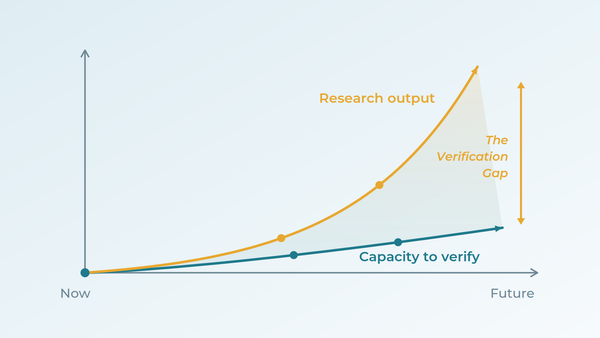
AI can now produce proposals, citations, and capability statements faster than an institution can check them, while verifying a single claim manually can still take about fifteen minutes. A proposal may arrive polished and well cited even when its citations do not hold or its claims about the team rest on assertion rather than evidence.
This gap is what we call the verification gap, and closing it means confirming that citations support their claims, that capability claims match demonstrated evidence, and that AI use is disclosed as the funder requires. Machines can run those routine checks, while people label what is verified and make the decision to sign.
Key takeaways:
- Before trusting any tool, ask where its answer came from, who can see your data, whether it can be checked afterwards, and who is accountable.
- Begin with the release checklist, then follow the 90-day plan built on free public sources.
Read the four working principles and the 90-day plan in The Verification Gap.
2. A Confidence Score is Not a Proof
A precise score can hide the reasoning behind it.
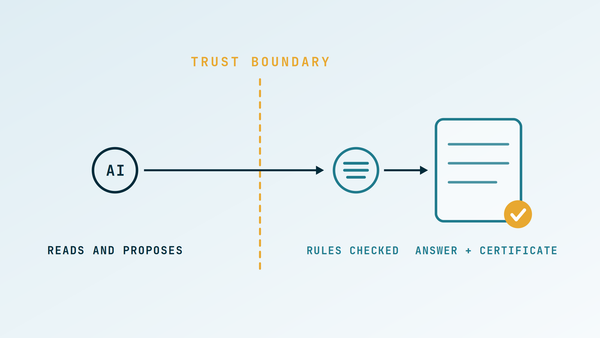
A patent claim is a set of interdependent requirements, and a single match score cannot show which one carried the result. Ascendr's research maps those requirements, lets AI score the evidence for each, and verifies every calculation after that by machine. The output is a certificate rather than a score, made up of the claim-to-evidence mapping and a proof that every calculation followed the stated rules.
In the paper's synthetic example, one requirement falls just below threshold and the three that depend on it drop to zero, which a flat score would never reveal. Because the certificate can be re-checked independently, any reviewer can confirm how the result was reached.
Key takeaways:
- Under the weakest-link rule, one requirement below threshold zeroes out everything that depends on it.
- The certificate proves the calculations, not the AI's reading of the language or the legal conclusion.
See why a certificate cannot be faked in A Confidence Score is Not a Proof.
3. Every High-Stakes AI Answer Should Carry a Verdict
An AI answer should make the limits of its own checks visible.
An AI system can report high support for a recommendation even when some of the documents it retrieved contradict it, because its score counts agreement and cannot represent disagreement. Rewording the question can also change the evidence retrieved, with no warning to the user.
The research answers with three certificates that cover conflicting evidence, stability across declared rewordings, and the conditions before and after an AI agent acts. A proposed assurance card summarizes the results under one of four verdicts, which are Certified, Partial, Residue, or Abstain.
Key takeaways:
- The Residue verdict releases the certifiable part of an answer and records what was withheld.
- Every certificate is conditional on its declared assumptions, and the assurance card is specified but not yet compiled.
Explore the architecture and the five questions to ask of any high-stakes AI system in Every High-Stakes AI Answer Should Carry a Verdict.
Explore the complete series in the Ascendr Library and discover more insightful resources.
Subscribe to the library and get the latest resources delivered straight to your inbox.
Written by the Ascendr Team
Ascendr, PBC is a public benefit corporation that believes every high-stakes decision deserves better than opinion. We wrote this series the way we build our products, with every claim traceable and every limit labeled. Through our writing, we share practical ideas that help research, IP, and technology teams make clearer, more defensible decisions.