NSF X-Labs: Funding, Research Priorities and What Research Teams Need to Know
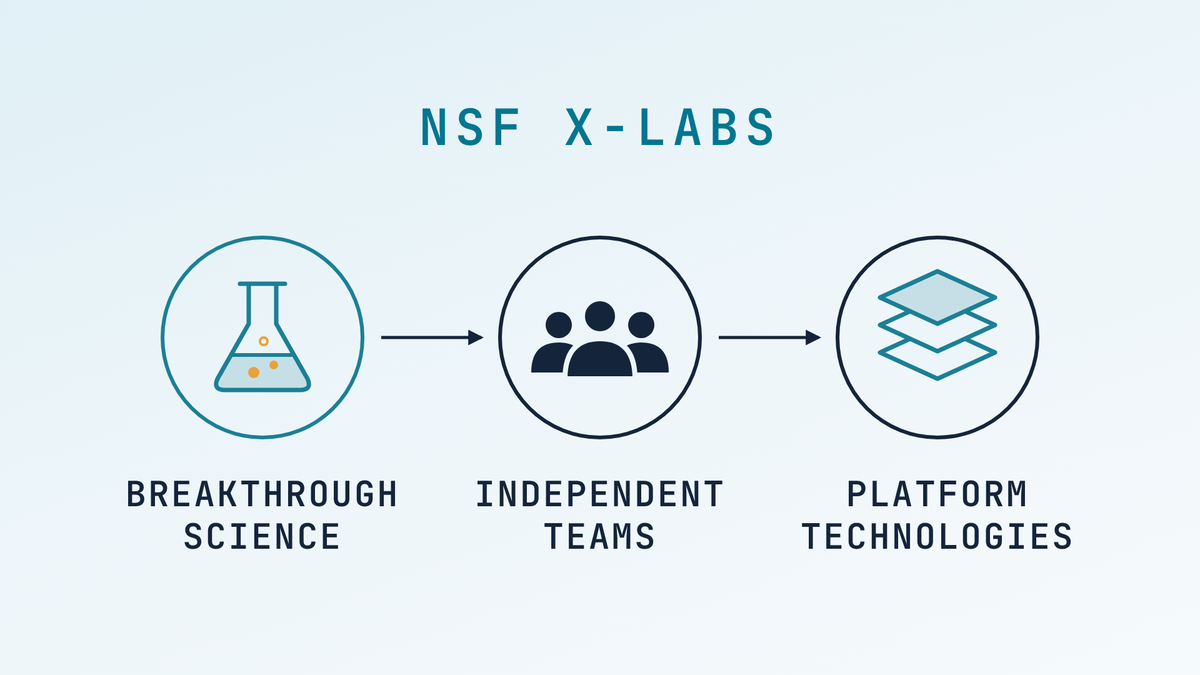
NSF X-Labs, a $1.5 billion funding initiative by the U.S. National Science Foundation, helps independent, full-time research teams turn breakthrough science into platform technologies. This guide covers its funding, research topics and practical guidance for research teams.
A research team may have the expertise to solve a hard problem and still lack the time, resources or freedom to pursue it. The work may cross departments, need unfamiliar partners, or take years of coordinated development before it attracts investment.
NSF X-Labs is designed for challenges like these. In May 2026, the U.S. National Science Foundation announced up to $1.5 billion over the next decade for independent teams developing technologies that could open new fields and industries. By 17 November, NSF had released all five topics, and three
remain open until early 2027.
For a research office, assessing the opportunity means looking at the science, the people and the organization behind them. Can the team define a clear technical mission? Can its leaders commit full-time? Can the institution support the independence NSF expects?
This guide brings together the funding, research topics, requirements and dates from NSF's own documents.
What X-Labs is designed to do:
NSF gives X-Labs two strategic goals: to build sector-defining platforms and to develop new organizational research structures. In practice, it funds full-time, independent teams working on use-inspired breakthroughs and platform technologies, the kind of capability others build upon. NSF points to PCR, next-generation sequencing and the Internet to show the scale of influence it has in mind.
Proposing teams specify their Mission, defined as the novel platform technology and key use-inspired research solutions that the proposed X-Lab is uniquely suited to tackle. They should have a clear vision of how their Mission will result in an end-state that creates or reshapes an entire field of scientific research or sector of technology, and how their Mission is currently unmet by existing organizational structures and funding mechanisms.
Awards are Other Transaction (OT) contracts with milestone-based funding, not grants, cooperative agreements or FAR-based contracts. Teams are expected to operate as an autonomous entity by Phase 1.
The five research topics:
| Research topic | What it addresses |
|---|---|
| Scientific Instrumentation for Sensing and Imaging | To build the next generation of scientific instruments drawing on quantum sensing, artificial intelligence-driven computational imaging and entirely new chemical modalities |
| Quantum Systems: Interconnects and Integrated Photonics | To develop novel components to transfer quantum information and integrate heterogeneous quantum systems |
| AI for Physical Systems | To accelerate entirely new forms of AI integration in physical systems, including advanced sensors, robotics, embodied systems, human-robot interfaces, and cyber-physical systems |
| From Sequence to Function | To enable the intentional design of individual proteins or entire genomes whose function is predictable and/or controllable |
| Computation at the Limit of Physics | To dramatically narrow the gap between the energy efficiency of conventional CMOS-based computing and the inherent physical limits |
NSF's X-Labs page and webinar call the physical AI topic "Super Intelligence for Physical Systems", while its topic announcement uses "AI for Physical Systems". Both names refer to the same opportunity.
How the funding works:
NSF describes the $1.5 billion as an initial investment over the next decade. Each team moves through phases, and continued support depends on Go/No-Go selections and milestone progress.
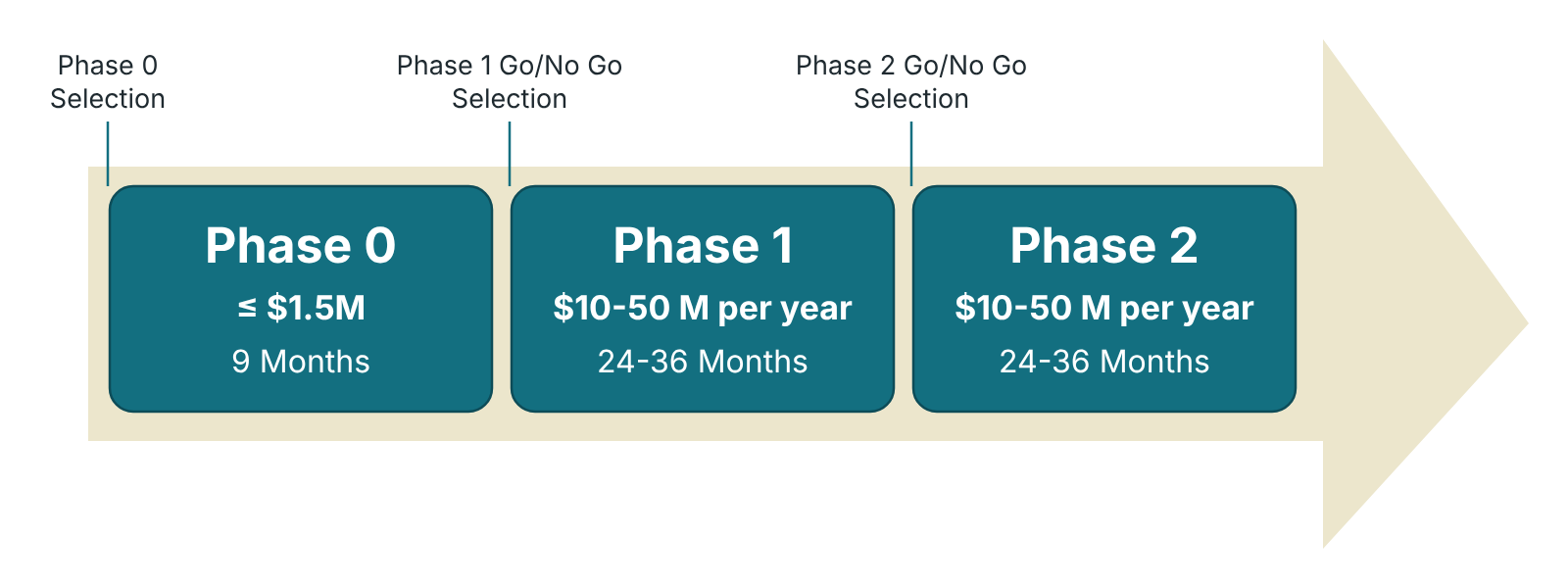
Milestones are discrete, predefined performance checkpoints specified in an OT contract that an awardee must satisfy and document to NSF before payment is released. NSF will reward significant, transformative progress even if not all milestones are achieved.
What participation requires:
Universities can participate, including as hosts while teams develop their operating structures. By Phase 1, however, NSF expects substantial independence over research decisions, staffing, funding, partnerships and daily operations.
NSF gives three example structures for an X-Lab and its lead organization:
- The lead organization is the X-Lab team.
- The lead organization hosts the X-Lab team through all phases. By Phase 1, the team is established as autonomous and affiliated with the lead organization.
- The lead organization temporarily hosts the X-Lab team during Phase 0. The X-Lab then spins out from its Phase 0 host and becomes the new lead organization.
NSF assesses whether the team can make decisions quickly and has full internal control of how funding is allocated, its research directions and partnerships, hiring, and the intellectual property it produces, including licensing. NSF notes that its example structures are not a comprehensive list.
Several conditions need attention before a team commits to applying:
- Leadership time: All Senior/Key Personnel are expected to be dedicated full time to the X-Lab team by the beginning of Phase 1.
- Partner arrangements: One lead organization per NSF X-Lab team will sign an OT contract with NSF. The lead organization may subcontract with partnering organizations.
- Research security: Senior/Key Personnel may not be citizens of China, North Korea, Russia, or Iran, parties to a Malign Foreign Talent Recruitment Program, foreign entities of concern, or U.S. proscribed parties (OTASO; Sect. 6.3).
Two proposals per topic, one per person:
Each organization may lead up to two written proposals per topic, and senior or key personnel may appear on only one proposal per topic. That turns every topic into a limited submission.
Research offices at CU Boulder, Boston University, UW–Madison and Stony Brook have run internal competitions within weeks of each release. Their internal deadlines fell anywhere from about one week to more than four months before NSF's, so selection needs to start soon after a topic is announced.
Where a proposal can fall outside scope:
A topic match is only the first check. NSF also asks whether the work warrants a dedicated X-Lab.
Across X-Labs, NSF excludes incremental improvements, multiple research efforts without a clear shared mission, technologies that already attract substantial private investment, testbeds or data centers as the primary objective, and missions whose only challenges are non-technical.
All three open topic announcements list as not in scope: development of technologies where the impact is narrow and not widely deployable, fundamental research without potential for application in platform technologies, and incremental advancement of the state of the art.
Each topic adds:
- AI for Physical Systems
- Not in scope: computational or software solutions without practical integration into a physical system; integration of current technologies without significant advancement of the state of the art; technologies already appropriately developed to the point of full-scale commercialization.
- Teams must justify that their Mission will develop a technology not presently supported by existing R&D investments by the U.S. public or private sector.
- From Sequence to Function
- Not in scope: standalone predictive models that do not generate or integrate new experimental data; technologies already developed or supported by existing R&D investments by the U.S. public or private sectors.
- Each team should identify 2-3 high-utility domains and eventually establish projects in them.
- Teams should identify how their approach to biosafety and biosecurity is tailored to their Mission and pilot application domains, including an assessment of dangerous gain-of-function and a plan to mitigate unintended consequences.
- Computation at the Limit of Physics
- Not in scope: technologies already appropriately developed or supported by existing R&D investments by the U.S. public or private sectors.
- Successful X-Labs will demonstrate 4-5 orders-of-magnitude improvements in effective computational throughput per unit power compared to conventional systems, measured at the system level, not solely at the switching device, memory cell or gate level.
- Teams should specify a target computational efficiency metric, justify how they will meet it and how it compares to known or posited physical limits.
- Teams must present a credible, quantitative argument for the net system energy efficiency gain after accounting for overheads such as data movement, memory access, synchronization, required cooling and control infrastructure.
How teams apply:
X-Labs runs on an Other Transaction Agreement Solutions Offering (OTASO), so its instructions differ from a standard NSF grant.
- Written proposal: up to eight pages. It describes the team's mission, the technology landscape, desired outcomes, the qualifications of senior/key personnel and team capabilities.
- Oral proposal: by invitation only. Invited teams submit an oral proposal package with a budget, milestone plan and senior/key personnel disclosures, then present live to a review panel.
Submissions go through the NSF X-Labs portal.
The dates to know:
The first two topics closed in July 2026. The three newer topics close in early 2027, each at 5 p.m. Eastern.
| Topic | Written proposal due | Anticipated Phase 0 start |
| AI for Physical Systems | 7 Jan 2027 | July 2027 |
| From Sequence to Function | 8 Feb 2027 | September 2027 |
| Computation at the Limit of Physics | 15 Mar 2027 | October 2027 |
Questions to NSF are due 14 December 2026 for From Sequence to Function and 28 January 2027 for Computation at the Limit of Physics, sent to XLabs@nsf.gov on the announcement's question template. NSF's webinar on the computing topic is on 13 January 2027, 1–2 p.m, Eastern. Start dates are NSF's anticipated schedule.
Where should a research office start?
Before a team decides to apply, a short conversation between the prospective lead, research development, sponsored programs and the colleagues responsible for staffing, IP and research security can help the team build a strong application. Bring three questions:
- The mission: what specific capability would this team create, and why does it need an X-Lab?
- The people: who has the demonstrated expertise, leadership and availability to deliver it?
- The organization: what must change for those people to work with the autonomy NSF expects?
The answers show where the team is strongest, which partners to approach and what to resolve before the written proposal. Read the umbrella solicitation and the chosen topic announcement together: one sets how an X-Lab must operate, the other defines the science it must address.
Sources: NSF's launch announcement (14 May 2026), announcement of three additional topics (16 September 2026), release of the Computation at the Limit of Physics topic (17 November 2026), X-Labs page, X-Labs webinar slides (4 June 2026), umbrella solicitation and topic announcements for AI for Physical Systems, From Sequence to Function and Computation at the Limit of Physics. Internal competition practice is from the research office pages linked above.
Written by the Ascendr Team
Ascendr, PBC is a Delaware public benefit corporation based in Mount Airy, Maryland. We develop decision intelligence for research, intellectual property, and technology strategy. Our public benefit mission also includes advancing education and entrepreneurship in communities worldwide.